

Hey it’s Dustin here with your Week Ahead report for Monday October 26th.
There is no audio for today as I’m on the road and unable to record. I will record and post the audio tomorrow morning if you prefer to wait to listen.
Markets are trying to find support after an aggressive sell off & fresh short positions being added by the funds. US harvest pressure, some reduced export demand & new supply pressure, and negative fund activity have been the main drivers as of late.
The sell-off has been more aggressive than anticipated, but it doesn’t mean we won’t see a recovery. Ideally, we need to see these first support levels hold to shorten the time we have to wait for the next sales.
Cash markets are holding up better on some crops. Oats remain steady despite the futures sell off, while feed barley is seeing some good offers in most regions. Durum prices are sideways with grade spreads still the big factor to watch.
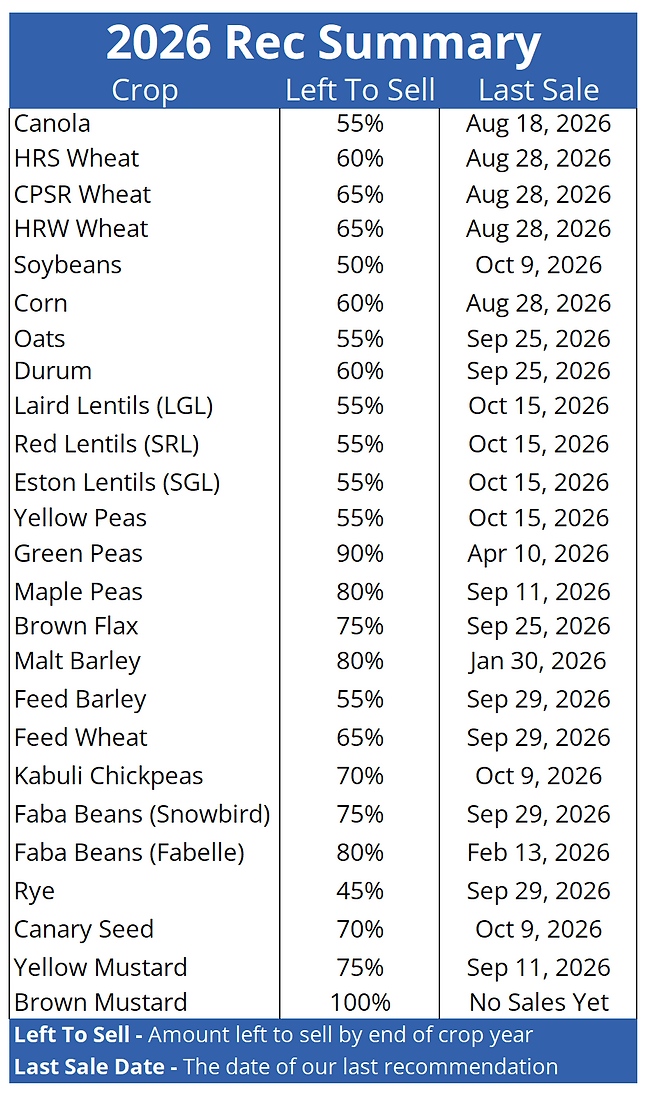
Pulses have been one of the better short term options and are holding in the same ranges over the last couple of weeks. The sales strategy remains to cash flow up to 40-50% sold and sit on the rest.
This week we have US Crop Progress, the EU Crops Bulletin, and interest rate decisions from both the BOC and FOMC. Our big news and fundamental review will be out Wednesday with more on the S&D outlook for individual crops. I’m also watching for confirmation of the lows and for buy signals on the weekly charts before updating our next target areas.

Canola
January futures are starting the week trying to hold above an important support level at $780/T after an aggressive sell off by the funds. US harvest pressure and weakness in soybeans are the main reasons behind the correction.
There is still a bullish outlook for canola. We just need to see this first support, or worst case the $740-760/T support, to hold in the next couple of weeks. That would shorten the time needed to wait for the next chance to sell at $825-850/T.
We also need to keep in mind the there is a lot more money flowing in and out of the market, making for exaggerated (bigger) moves up and down. For that reason the recovery can be a similar pace as the pullback because of the bullish S&D outlook for canola.
Wheat
December Minneapolis wheat has nearly completed a full retracement back to the contract low at ~$6.25/bu. Another overdone sell off by the funds. December Kansas & Chicago futures are on a similar path with support at $6.25/bu and $5.90/bu respectively.
The fundamental outlook may not be as bullish as oilseeds but there are still some pieces of the S&D that suggest wheat will make at least a 50% retracement, even a full retracement back to the contract highs.
Some resumed Black Sea shipping and harvest pressure from bigger production in Canada and Australia are the main reasons behind the sell off. There is still a 4% lower global stocks than last year, export issues, and El Niño effects that can help turn prices back up.
Watch for basis opportunities on March futures if you need movement and wait for the recovery to lock futures. Once the lows are confirmed with some buy signals on the weekly charts we will update the target areas to aim for.
Soybeans
January soybeans gapped lower this morning and are challenging the support range at $12.30-12.40/bu. This a must-hold range, to avoid seeing further correction down to $11.80-12.00/bu.
Canola and beans are tracking a similar path right now, but soybeans have a less bullish outlook because of a big US crop, and potentially a big SA crop if there aren’t any weather issues during their peak growing season from now to new year. I am reading about excessive moisture and flooding delaying planting in some areas right now.
The two big bullish factors are the strong & still growing demand for biofuel and China’s import pace. Stocks will remain on the tight side with those two things in place.
We are still targeting a recovery to $13/bu or better for the next sales. It’s just timing that is the issue right now. Holding that first support will keep the time to wait shorter.
Corn
December corn continues its search for support and the funds seem to be selling until futures touch all the way back to the contract low at $4.25/bu. This has been a much more aggressive harvest pressure sell off than we were anticipating, but it doesn’t mean we won’t see a 50% retracement or full recovery similar to wheat.
The biggest driver of the sell off is US harvest and less export demand. But a tighter global grain stocks and demand from biofuel & El Niño impacts should help bring futures back up to $5.00-5.50/bu. We are also keeping an eye on any indications that second crop corn in Brazil will be delayed because of the wet forecast pushing beans back.
This is the one crop we didn’t get enough sold on this last run, but there’s still time. Strong feed demand and improving basis will also support a better cash price in Canada.
Oats
December oats are seeing some extended pressure along with corn and wheat. They broke the $3.80/bu support last week and are now moving toward the next support at $3.60/bu.
Cash prices remain steady with lingering quality issues in Canada and a steady demand outlook for milling grades. I still think the lowest price to sell oats is $4.50/bu in low priced regions and $5/bu in high priced regions. Hold good quality if you have it.
Peas
Pea markets are holding in the same range as the last couple of weeks. Yellow and Green are $9-10/bu across the Prairies. There have been a few $10/bu greens showing up in some of SK and into AB, but prices remain held back by a high carryover. Chickpeas are holding steady at .29-.32/lb.
Indian imports are up more than 60% from last year. Their Rabi crop is on pace at the moment, but many are still forecasting El Niño to negatively impact their crops. Australia chickpea supply was way down from last year. That’s big support for Kabuli’s and Yellow Peas. There’s a few other S&D pieces that are supportive. We will touch on those in our news update later this week.
Sell yellow peas and chickpeas for cash flow up to 40-50% sold. Only sell some green peas if you are seeing $10/bu. I would prefer to sit on them until demand improves a bit and stocks draw down over the next couple of months.
Lentils
SRL continue to trade around .25-.26/lb, LGL are .29-.31/lb, and SGL are .26-.28/lb. Prices may be a bit higher than this. I haven’t been able to access a couple price sources this morning to get updates from all the companies I follow.
Lentil prices will move on similar fundamentals to peas. The two things we need to be mindful of are Aussie SRL harvest pressure and Ramadan demand lulls in December. That can often keep prices quiet for a couple of months. We will touch on some more specifics for each variety in our news update on Wednesday.
The sales strategy is the same for all pulses. Cash flow up to 40-50% and sit on the rest to see how much the bullish S&D outlook can push prices up in the next few months. We may up the sales to 60% if it looks like Aussie supply is going to pressure the SRL market for a bit.
Durum
Cash prices are sideways from $8.75-9.00/bu with higher grades fetching a premium in some areas. The grade spreads on durum in Canada continues to be the big factor to watch. North Africa demand has softened and the recent wheat/corn sell off isn’t doing us any favours right now.
I would continue selling #4 or lower at current prices. There is no reason to hold lower grades at this point. I would consider some sales at $9/bu if you can get a package deal going with #1 - #3 grades, but I wouldn’t sell everything just yet. And if you have top two grades I would sit on it for a bit longer with the goal of selling for $10/bu or better.
Barley
Feed barley has been varied lately with offers of $5/bu or better available in most regions. The high end in south AB seems to be hanging in a range from $5.90-6.20/bu.
Chinese imports are the biggest factor that can help lift feed prices. If they go back to record paced importing it will offset pressure from corn & higher feed supply in Canada. It sounds like they will be a big market again, depending on their Aussie connection. Will chat more about that in the news on Wednesday.
I haven’t heard any new malt bids since last week. The high end offer was still around $7/bu from what I can see through my sources. We haven’t made the call on a rec yet and will be deciding that next week. On one hand we have limited malt quality and the other hand we have lower wheat and corn values adding some hesitancy.
The Rest
Flax is range bound at $17-18/bu. We are making small sales in this range and waiting for a shot at $20/bu for a bigger sale.
Canary seed is stuck at .20-.21/lb. We are still recommending sales in this seasonal window. Yellow mustard had a small bump to .41/lb last week. We are holding off sales at the moment.
I have to get a new update on rye prices before I make any suggestions. I haven’t heard back from my rye sources yet to see if prices have backed off from the higher range traded over the past couple of weeks. I will get some more info out later this week.



Oct 26
US Crop Progress
EU Crops Bulletin
Oct 28
BOC Interest Rates
FOMC Interest Rates

-
Big News & Fundamental
-
Review Wednesday
-
Watching for low confirmations
-
Cash & target reviews
-
+ The Usual Reports



We use zones to reference prices, targets, in our Q&A report and more! Get the most out of your subscription by knowing your zone!
